MWC 2026 Recap: Honor’s Robots, Samsung’s AI, and the Future of Mobile Development
Imagine your smartphone is no longer just a screen with icons, but a physically responsive companion capable of tracking your every gaze. MWC 2026 has officially blurred the line between sci-fi and production-ready code by introducing devices that redefine the core of mobile UX. This breakdown is your essential guide to navigating a world where hardware has finally learned to "sense" the user.

Forget traditional mobile interfaces – the era of autonomous AI agents and next level hardware privacy is already here. We have curated the most disruptive reveals from the show floor that will force you to rethink your Flutter and .NET MAUI app architectures. Prepare to discover which technologies from Samsung to Honor will become your primary development tools this season.
Samsung: Pixel-Level Privacy and Agentic AI
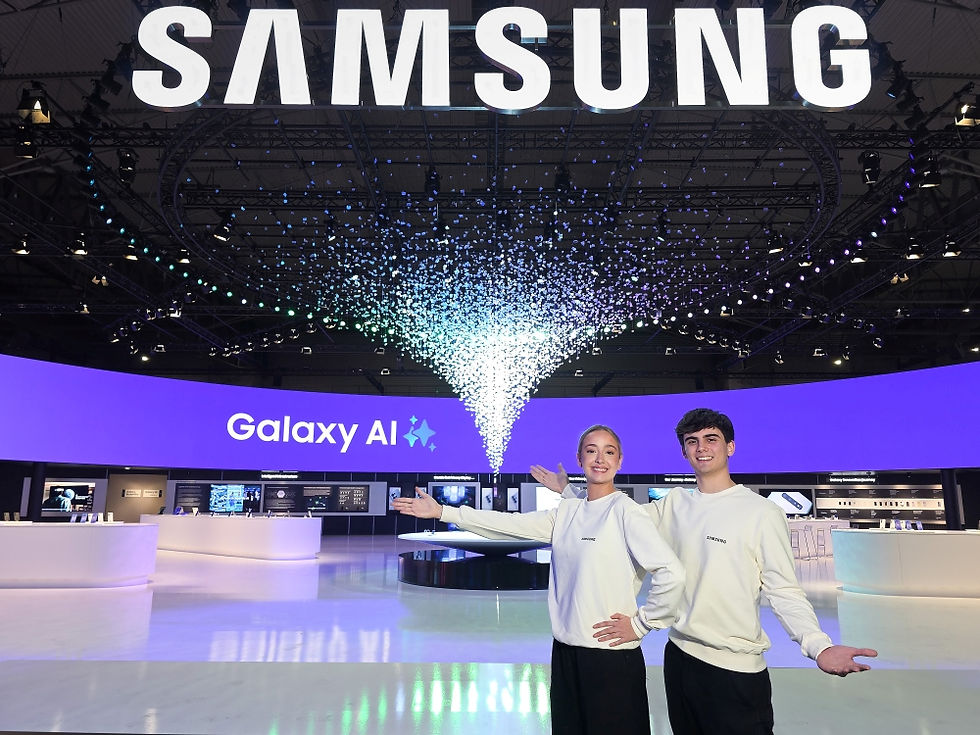
Samsung’s booth was packed this year: the company showcased not only the award–winning Galaxy S26 Ultra but also experimental panels that literally change shape. The brand’s core message is clear – AI should become an invisible assistant, while hardware must be perfectly adaptive to the user’s context.
Privacy Display: Flex Magic Pixel
The show’s main triumph, the Galaxy S26 Ultra, arrived in Barcelona with more than just a hardware refresh – it introduced Privacy Display technology. This built-in solution uses a hardware-level layer to narrow screen viewing angles at the touch of a button.

For Flutter and .NET MAUI developers, this opens up a new frontier. With the upcoming One UI 8.5 APIs, your app will be able to programmatically "hide" sensitive data or private chats from prying eyes the moment a user enters a crowded public space.
Agentic AI: From Commands to Intentions
Samsung introduced the concept of Agentic AI that operates in the background. Thanks to deep integration with Google Gemini, the smartphone can perform complex sequences of actions: for example, reading a group chat, booking a table via a third-party app, and adding the event to the calendar.
This presents a specific technical challenge: for your app to interact seamlessly with the Galaxy ecosystem, you must prioritize semantic labeling and Accessibility layers. This is the only way an AI agent can "read" what is happening on your cross-platform app's screen and help the user complete complex actions in a single click.
Knox KEEP: A "Safe" for Your AI Data
As AI takes on a bigger role, a critical question arises: where are our preferences, schedules, and habits – all analyzed by the system – actually stored? Samsung introduced Knox Enhanced Encrypted Protection (KEEP), a new security architecture that creates isolated, encrypted environments for every AI feature.

This means the data used by your personal agent isn't just sitting in the phone's memory; it is protected at a hardware level within Knox Vault. Even if the system is compromised, an attacker wouldn't be able to "extract" your interest profile or AI interaction history, as every process is strictly isolated from one another.
Mobile Slidable: The Expanding Screen
Beyond the S26, Samsung showcased a Slidable prototype – a compact 5.1–inch smartphone that smoothly expands to a 6.7-inch display. Unlike foldables, there is no visible crease, and the surface area increases via a motorized rolling mechanism.
This is yet another challenge for adaptive layout design. We need to build interfaces that fluidly transition between aspect ratios (from 16:9 to 22:9) without restarting the app.
Super Steady AI 2.0: Cinematic Stability
The updated Super Steady technology now leverages the power of the neural processing unit to achieve a total Horizon Lock effect. The system analyzes every frame in real-time and predicts the movement trajectory to completely eliminate physical camera shake. Even during intense running or 360-degree smartphone rotations, the footage remains perfectly level – as if the camera were mounted on a professional gyroscopic gimbal.
This level of stabilization is made possible because the AI no longer just crops the frame; it literally reconstructs the image and compensates for lens distortion on the fly. This transforms a standard smartphone into a powerful tool for action cinematography, eliminating the need for bulky external stabilizers. For the user, it means achieving "Hollywood-style" smoothness in any environment, no matter how extreme.
Connected Care: Health as an Ecosystem Core
Samsung also unveiled its Connected Care concept, taking the Samsung Health app to a new level. Following last year’s acquisition of the US-based company Xealth, the brand has focused on integrating personal user data with professional healthcare platforms.

This is no longer just a step tracker; it is a comprehensive digital health hub. Leveraging data from Galaxy Watch and AI-driven analytics, the system can provide real-time health reports to your physician (with your explicit consent via Knox KEEP). This transforms the smartphone into a bridge between daily monitoring and clinical medicine, making predictive diagnostics accessible to every Galaxy device owner.
The Verdict: An Ecosystem That Thinks Ahead
At MWC 2026, Samsung proved that the smartphone has evolved from a mere tool into an active participant in the user's life. From pixel-level data protection to predictive medicine, the brand is building an environment where technology anticipates needs before they are even voiced. For us, the signal is clear: the future lies in deep software integration with hardware capabilities and AI-driven services.
Honor: The Magic of Embodied AI and Mobile Cinema
While Samsung focuses on the broader ecosystem, Honor at MWC 2026 decided to literally "give AI a body". The brand’s central theme was the concept of Embodied AI – a technology that transforms the smartphone from a passive gadget into an active participant that physically interacts with the user and their surroundings.
Honor Robot Phone: The Smartphone That Lives
The centerpiece of the show was the Robot Phone, a device featuring a unique 4-axis drive and integrated micromotors. This system allows the 200 MP camera to rotate 360°, tilt, and find the perfect angle while physically tracking the user’s movement. The phone no longer just sits there. It "emotionally" reacts to you – nodding in response or even swaying to the beat of your music.
This physical automation works in tandem with AI Object Tracking and AI SpinShot algorithms. The device doesn't just keep you in the frame. It executes cinematic transitions, such as professional 90° and 180° pans, that previously required expensive gimbal rigs. Most notably, the partnership with ARRI brings legendary color science and depth-of-field processing to a mobile device for the first time, effectively turning your phone into a professional movie camera.
Magic V6 and the Honor Blade Concept: The Evolution of Thinness
The foldable flagship Honor Magic V6 was the serial star of the booth, setting a new standard for compactness. When folded, its thickness is just 8.75 mm, making it virtually indistinguishable from traditional slab phones. Engineers achieved these dimensions without compromising on battery life: hidden inside is a 5th-generation silicon-carbon battery with a 7,100 mAh capacity. This device clearly demonstrates how modern materials eliminate the trade-off between the foldable form factor and daily convenience.

However, behind this commercial success lies an even more radical development – the Honor Blade technology. At the exhibition, the company showcased a prototype battery of the future with a record-breaking energy density of 900 Wh/L. To emphasize the incredible rigidity and thinness of the cell, Honor conducted a striking demonstration: the battery plate was used like a real knife to slice through fruit. This "Blade Battery" concept will serve as the foundation for the next generation of gadgets, allowing them to be even thinner by turning the battery itself into a structural component of the chassis.
The Verdict: Hardware Comes to Life
At MWC 2026, Honor proved that the future belongs to active hardware. A smartphone is no longer just a flat screen in your pocket; it is becoming a spatially aware device that physically adapts to the user. For the industry, this marks the end of the "static brick" era and the beginning of "living" gadgets that interact with the physical world.
Tecno & Infinix: Modularity, Satellites, and "Eternal" Batteries
These two brands at MWC 2026 proved that innovation isn't just about foldable screens – it’s about solving real-world problems, from battery degradation to staying connected in the most remote corners of the planet.
Tecno Modular Concept: The Smartphone as a "Lego" Set
Tecno has effectively resurrected the idea of modular phones with its Modular Magnetic Interconnection technology. They showcased an ultra-thin smartphone concept, measuring just 4.9 mm, which allows users to instantly "snap on" functional blocks via a magnetic back panel.
The Mechanism: The rear of the device features high-strength magnetic zones and Pogo-pin connectors.
The Modules: Users can attach a slim external battery (adding only 4.5 mm of thickness), a professional-grade telephoto lens, or a high-performance action camera module.

Unlike previous modular attempts (like Project Ara), Tecno’s approach doesn't make the phone bulky. Even with an extra battery attached, the device remains thinner than most of today's traditional flagships.
From a mobile app development standpoint, such a physical "upgrade" presents a fascinating new set of challenges. Software must now be exceptionally adaptive: the interface needs to react instantly when an external module is connected, granting access to deep peripheral settings or redistributing system resources.
Infinix Note 60 Ultra: Satellite Freedom and Self-Healing Tech
In partnership with the legendary Pininfarina design house, Infinix introduced what is arguably the most practical flagship of the exhibition: the Note 60 Ultra. This device redefines the concept of reliability, offering solutions for those who refuse to be limited by their environment. It stands as the first commercial smartphone to feature full two-way satellite communication, allowing for not just emergency texts, but high-quality voice calls in areas where cellular networks simply do not exist.

However, the true technical revolution is hidden within: the Battery Self-Healing technology. Addressing the primary flaw of modern lithium cells, Infinix has implemented a self-restoring system for its 7,000 mAh battery. Through intelligent management of internal chemical processes, the battery can actually repair its own structure, minimizing degradation even after hundreds of charging cycles. Combined with its satellite autonomy, this transforms the Note 60 Ultra into a truly independent tool, built to perform for years under the most extreme conditions.
The Verdict: Real-World Technology
The presence of Tecno and Infinix at MWC 2026 clearly signaled a paradigm shift in the industry. While established giants focus heavily on software features and ecosystem lock-ins, these brands are bringing innovation back to the hardware itself. Modularity, satellite connectivity, and self-healing batteries are not just bullet points on a spec sheet; they represent a fundamental rethinking of smartphone reliability and flexibility. Today, innovation is no longer defined by how bright a screen is, but by how long and under what conditions a device can remain a vital, functioning tool.
Conclusion
The Mobile World Congress 2026 has proven that we are entering a new era of personal technology. If previous years were dominated by the "AI in the cloud" hype, this year was about Embodied AI and Physical Innovation. From Samsung’s seamless ecosystem to Honor’s "living" motorized devices, and from Tecno’s modular versatility to Infinix’s extreme hardware resilience – the message is clear: the smartphone is no longer just a window to the internet; it is becoming an active, intelligent partner that physically adapts to its user.
We are witnessing the end of the "static brick" era. The innovations of 2026 – 900 Wh/L batteries, satellite voice calls, and 4-axis motorized frames – are not just gimmicks; they are the new foundation for the next generation of mobile experiences. For developers and businesses, this means the apps of tomorrow must be as dynamic and adaptive as the hardware they live on.
Ready to turn the innovations of MWC 2026 into your next big success?
Whether you have a vision for an AI-driven ecosystem or a unique modular app experience, we’re here to bring it to life. Let’s build the future together – contact us today!


Comments